Manual provisioning
Multiple consoles and hand-offs slow delivery and create inconsistent outcomes.
 Request a briefing ↗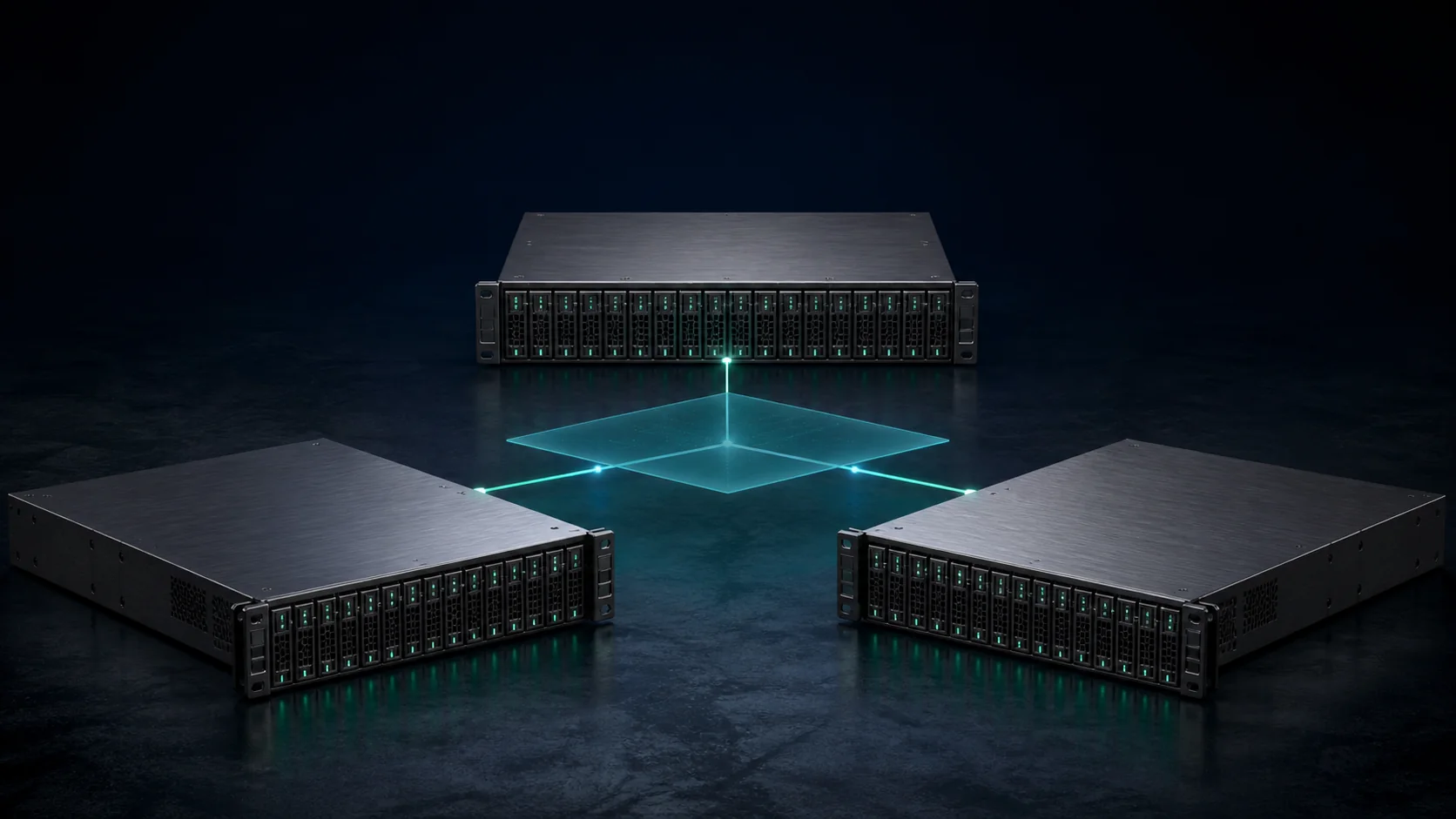
03 / STORAGE ON DEMAND
Request the capacity, performance, protection and location a workload needs. Storage on Demand coordinates file or block service provisioning across supported storage systems—with policy checks and operational visibility.
THE NEED
Across mixed storage estates, separate consoles and approval processes can obscure available capacity and slow provisioning. The challenge is to coordinate performance, protection, cost and data location without replacing every system.
Multiple consoles and hand-offs slow delivery and create inconsistent outcomes.
Capacity and policy are fragmented across systems that do not operate as one fabric.
Stranded capacity, limited forecasting and poor visibility increase cost.
Modern workloads require performance, locality, protection and rapid change at the same time.
THE IUNOVRA RESPONSE
On a prepared estate, a request becomes an approved file or block service. The hardware, network, connectors and access policies must first be integrated and tested. “On demand” describes service provisioning—not unlimited capacity, instant site deployment or an automatic pay-per-use contract.
Specify capacity, performance, location and protection needs. GraphQL and user-interface options form part of the reference design; the implemented request interface is agreed in scope.
The provisioning engine checks policy, available resources and permissions before coordinating service creation.
Select eligible capacity and network resources within the configured service and location boundaries.
Discovery agents report inventory and health; supported workflows configure storage, access and protection.
Present the selected file or block service to the workload. Feed status and telemetry into InfraMind for governed operations.
WHAT YOU RECEIVE
Technical descriptions include reference designs and configuration options. The proposal separates demonstrated functions, integrations to validate and development work; only the agreed scope is included. Performance and service commitments follow the acceptance criteria.
DELIVERY MODEL
Confirm hardware, network, workload and data-protection requirements.
Install the control layer, agents and selected service components.
Test provisioning, workload performance, access and recovery behaviour.
Agree responsibilities, monitoring, support and acceptance criteria.
Extend to additional workloads or sites after capacity and readiness checks.
TECHNICAL DEPTH
The reference architecture covers parallel file storage, shared files and block devices. Service availability, component versions and integrations are confirmed for each deployment—not every option is included in every configuration.
HARDWARE CHOICE. SHARED SERVICE LOGIC.
Connected systems retain their physical identity. A common service layer coordinates discovery, policy and provisioning across the supported estate.
For AI and HPC jobs that need concurrent access to large datasets. Example: a research cluster reading training data or writing simulation results. Throughput depends on the complete storage and network design.
For applications and teams that need a common file service. Example: shared datasets for an analytics team, with access rules, capacity and protection defined for that service.
For workloads that consume block devices rather than shared files. Example: database volumes sized around latency, I/O demand and recovery requirements.
Reference components include NVMe SSDs, JBOF flash enclosures and NVMe-over-Fabrics connectivity. Network transport and ZFS-based storage options are selected where appropriate and validated for the service architecture.
Pacemaker-based high-availability options require a defined cluster design and failover tests. Recovery objectives, protection and backup arrangements are agreed explicitly; failover alone is not a zero-data-loss guarantee.
Local discovery agents—called Disk Jockey in the reference design—feed inventory and health into the platform. Supported InfraMind integrations add topology context, monitoring and recommendations; predictive functions require deployment-specific validation.
VALUE + DECISION MODEL
The customer case combines faster service delivery, better use of installed capacity and a controlled path to expand only when demand requires it.
Validate service definitions, integrations, controls and measurable operating improvement.
Give infrastructure teams one governed way to deliver data services without replacing every system.
Coordinate data placement and lifecycle across a distributed AI infrastructure estate.
HOW THE CASE IS VALIDATED
Measure provision time, usable versus installed capacity, service-level performance, protection overhead and planned purchases.
Quantify deferred hardware purchases and reduced stranded capacity without assuming every free terabyte is usable.
Measure fewer manual steps, faster delivery and reduced policy or configuration errors.
Agree service levels, support responsibilities and software costs as capacity and operating needs evolve.
Initial platform deployment includes assessment, integration and acceptance testing. Subsequent service provisioning is a separate process on a prepared estate. Savings and utilisation improvements depend on workloads, protection overhead, contracts and safely reusable capacity; customer baselines are required before any quantified claim.
CUSTOMER BENEFITS
Policy-driven automation reduces manual steps. Activation time depends on integrations, approvals, capacity and the requested service.
Discover and reuse available capacity before buying unnecessary infrastructure.
Standardise the operating experience across supported platforms, with compatibility confirmed before deployment.
Select performance and cost tiers against workload requirements, then review them using observed utilisation.
WHY IT IS STRATEGIC
Capacity, protection and platform operations can expand with customer workloads and agreed service levels.
Supported storage integrations share operational context with compute, power and cooling. Recommendations and control actions depend on the connected data and validated workflows.
The model can grow from one cluster into a distributed, policy-governed data fabric.
LET’S DISCUSS YOUR PROJECT