Typed resources and relationships
A common schema describes connected hardware, software, users, workloads and policies while preserving links to their source systems.
 Request a briefing ↗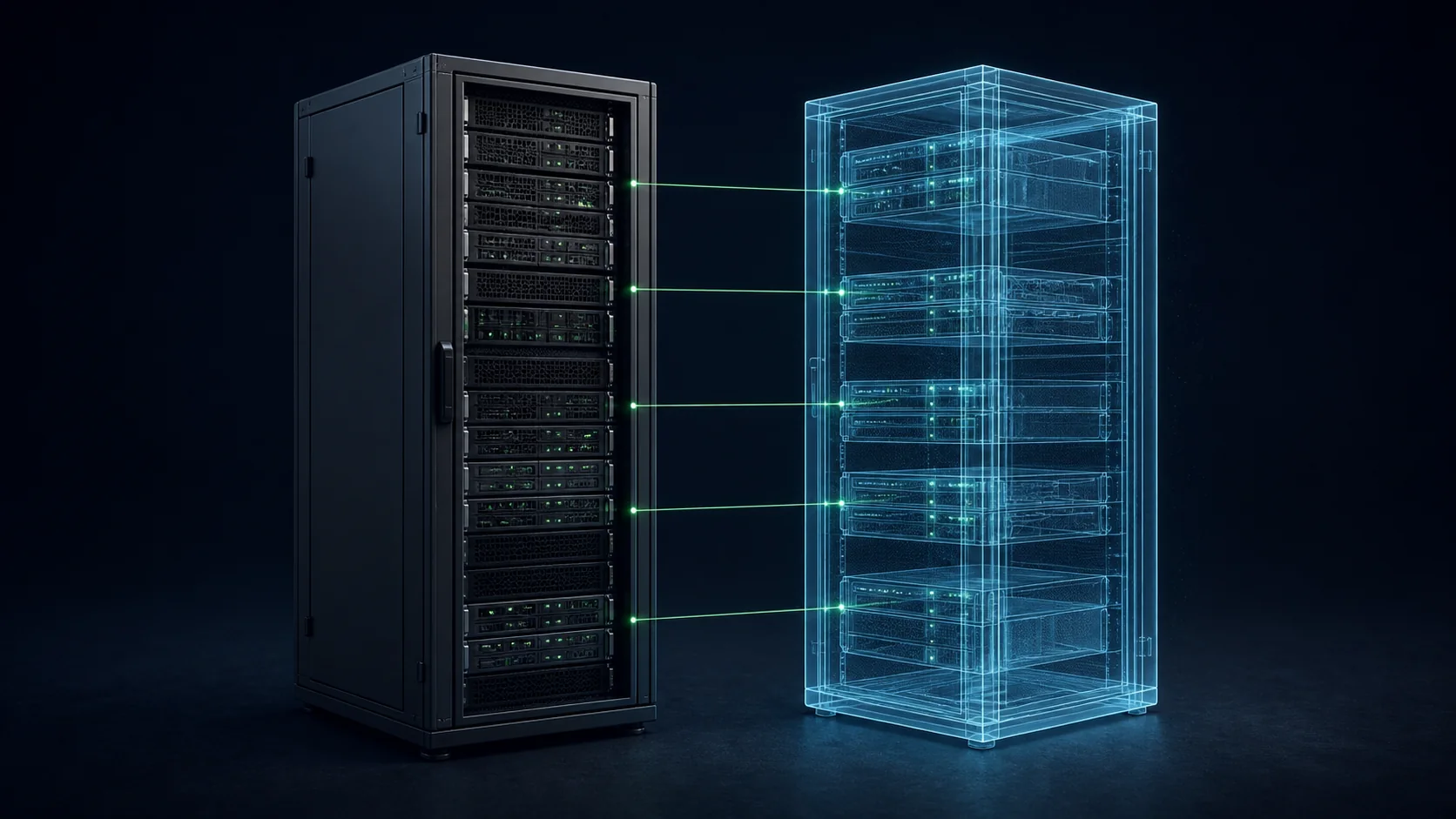
THE AI OPERATING LAYER FOR COMPLEX INFRASTRUCTURE
InfraMind connects people, applications and AI to a shared digital twin of supported infrastructure. See dependencies, understand operating state and coordinate permitted actions—from one data centre to a distributed estate.
DISTRIBUTED INFRASTRUCTURE. COORDINATED OPERATIONS.
InfraMind connects operations within a single data centre and across supported AI PODs, storage platforms and edge sites. Its federated digital twin brings infrastructure state, dependencies and permitted actions into a shared operating context—without replacing local systems.
From commissioning and resource provisioning to monitoring, incident diagnosis and maintenance planning, the aim is one connected operational lifecycle. Predictive maintenance and automated corrective actions require the relevant telemetry, models and validated workflows.
THE DIGITAL TWIN
Connected assets and software resources are represented as typed nodes in a federated model. Supported interfaces expose state and permitted actions; coverage and data freshness depend on the integration.
PHYSICAL INFRASTRUCTURE + DIGITAL CONTEXT
InfraMind connects resources, relationships and live state in one model, giving people and AI the context needed for governed action.
A common schema describes connected hardware, software, users, workloads and policies while preserving links to their source systems.
The graph reflects connected sources; freshness, gaps and synchronisation depend on the underlying systems.
Supported monitoring and control interfaces bring observation and authorised actions into the same operating context.
Each integration adds the resources, relationships and actions its connector supports. AI-assisted workflows and simulation require their own data and validation.
The operational twin represents connected resources and their state. Predictive simulation, thermal modelling and autonomous optimisation are separate capabilities—not automatic consequences of having a digital twin.
SCHEMA-NATIVE AI
The schema gives AI a structured description of connected resources, relationships and permitted operations. Type checking helps validate requests; it does not by itself guarantee a safe or correct decision. Approval rules and runtime controls remain essential.
Collect live telemetry across compute, accelerators, storage, network, power, cooling, jobs and security.
Connect assets, dependencies and operating state. Predictive models require relevant data and separate validation.
Assess available actions against policy, workload priorities, site capacity and operating risk.
Execute supported provisioning and remediation workflows with permissions, approval rules and an audit trail.
Before deployment, agree three things: demonstrated functions, integrations still to validate and research objectives. Visibility, recommendations and execution have different data, role-specific permissions and acceptance requirements.
ILLUSTRATIVE OPERATING WORKFLOW
Example: an operator needs capacity for an inference service with a defined data location. This illustrates the intended workflow, not a claim of an already deployed autonomous scheduler.
Define compute, storage, location and service requirements.
Review connected resources, current utilisation and relevant site constraints. Flag missing or stale data.
Compare an eligible option against access, capacity and data policies. The operator decides whether to proceed.
Run an authorised provisioning action only where a validated connector and approval workflow exist. Otherwise hand over the task.
Check the action result and service telemetry, retain the audit record and investigate exceptions.
WHAT YOU RECEIVE
Technical descriptions include reference designs and configuration options. The proposal separates demonstrated functions, integrations to validate and development work; only the agreed scope is included. Performance and service commitments follow the acceptance criteria.
TARGET OPERATING OUTCOMES
Measure the first workflow against a baseline: time to provision, manual steps, resource utilisation and incident resolution. The outcomes below are targets to test, not measured customer results.
SOVEREIGN OPERATIONS
Our software and engineering approach supports customer choice over infrastructure and operations. Each deployment must define administrator access, model hosting, telemetry flows, encryption-key ownership and external service dependencies.
Portability, licensing, support and continuity arrangements belong in the operating agreement. Proprietary software is part of the architecture—not, by itself, proof of sovereignty or regulatory compliance.
START WITH ONE MEASURABLE WORKFLOW
Select the infrastructure domain, target outcome, interfaces and approval rules—then scope a measurable pilot with an expansion path.